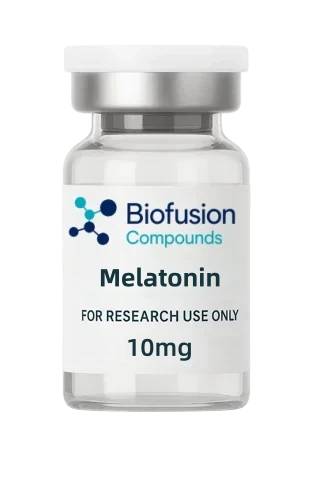
Product Details
Epithalon 10 mg research-grade lyophilized peptide powder in a glass vial. Epithalon (Epitalon, AEDG) is a synthetic tetrapeptide Ala–Glu–Asp–Gly that mimics the endogenous pineal peptide Epithalamin and is studied in models of pineal gland function, telomerase activity and cellular aging.
Research Use Only: All products are intended exclusively for laboratory and scientific research. Not for human or veterinary use.
Specifications
| purity |
99%+ |
| Form |
Lyophilized peptide powder |
| Content |
10 mg Epithalon per vial |
| Packaging |
Glass vial with sterile closure |
| Storage |
Store lyophilized at 2–8 °C (desiccated, protect from light) |
| Molecular Formula |
C14H22N4O9 |
| Molecular Weight |
≈ 390.35 g·mol⁻¹ |
| Sequence |
Ala–Glu–Asp–Gly (AEDG) |
| CAS Number |
307297-39-8 |
Research Overview
Epithalon (Epitalon, AEDG) is a synthetic tetrapeptide derivative of the pineal extract Epithalamin. In gerontology and cellular biology research it is used as a tool compound to study telomerase regulation, telomere maintenance and pineal gland–driven neuroendocrine signaling in aging models.
Primary Research Areas
- Telomerase & telomere maintenance: models investigating telomerase activity, telomere length dynamics and chromosomal stability in aging cells.
- Pineal gland & melatonin regulation: studies of pineal peptides, melatonin secretion patterns and neuroendocrine control of circadian biology.
- Circadian rhythm & clock-gene research: experimental systems exploring links between AEDG peptides, circadian timing and cellular clock mechanisms.
- Cellular aging & senescence models: in-vitro studies on replicative senescence, stress resistance and age-associated signaling pathways.
- Neuroendocrine & stress-response pathways: research into how pineal-derived peptides modulate hypothalamic–pituitary axes and systemic homeostasis.